Michelle: It’s usually laughed off of like, “Yeah, [ __ ] that. Don’t want to be around that person.” Whatever it might be, without actually getting to know them. You’re writing them off almost in a commodifying way of like, “I’m seeing this product on the shelf that I don’t want, so I’m not even going to give it my time. I’m going to go try and find the thing that I do want. Almost like…
Musical interlude
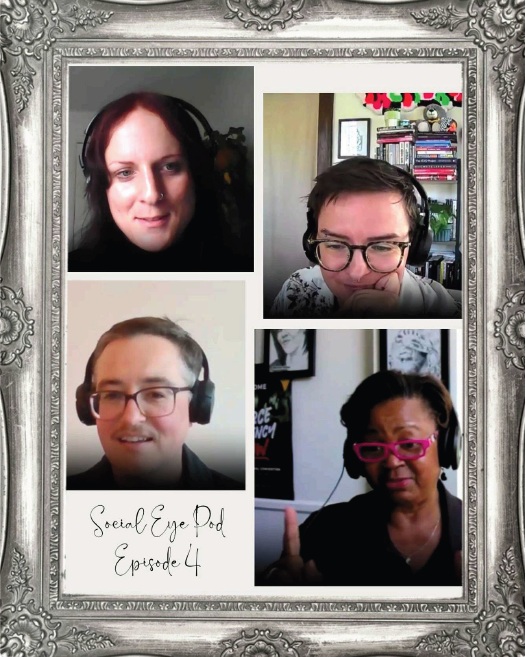
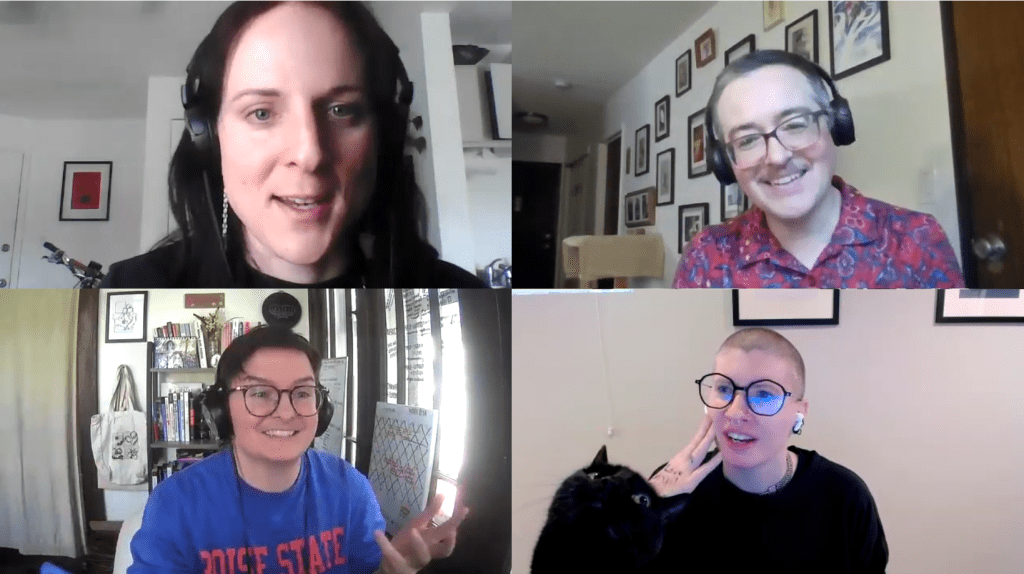
Wynn: Welcome to the Social Eye Podcast. Using sociology to explore big ideas. Exploring the taken for granted in everyday social life. Breaking down the complexity of institutionalized issues and inequality through lived experience. I am one of your hosts, Wynn. I use they/them pronouns.
Winona: I am one of your hosts, Winona. I use she/her pronouns.
Michelle: I’m another one of your hosts, Michelle. I use they/them pronouns.
Iris: And I am the fourth host. And my name is Iris and I use they and she pronouns.
Michelle: Hi. Hey everyone. Wynn, why are we talking about community today?
Wynn: Community has been on my mind a lot lately. Um, in the last, I mean beyond the last year, but um, in the last 8 months, it’s been really on my mind. Um, and that has to do with Trump’s election and sort of my own personal feeling of wanting to be connected with other people. I’m wanting to have strong connections so that I can be part of a larger social movement, a larger, like it’s together, we make change, right? It’s the whole thing of sociology. So, previous to that, there’s been in my public health research that I’ve worked on, the idea and conversation of community has come up. I collaborated on a paper that was connecting queer experiences with violence and thinking about the importance of community when things like that happen. Right? In the last several years, the news has shared this alarm from public health folks that, mental and public health folks, that have identified what is called a loneliness epidemic. A lot of people have probably heard of that. We have in the last 25, 30 years, moved more, switched jobs more, and then our technology has really changed and shifted how we interact. We have fewer built shared environments to meet others, and thus we feel less connected to others. And this has like health consequences, which is why it’s in the public health domain. So that’s, uh, you know it’s this, like our current social conditions, political conditions, has this concept on my mind. It’s a big reason why we are here on this podcast, wanting to connect with other people who are interested in having complex conversations and looking at and thinking about these sorts of ideas. And so, I want to ask each of you what, when you think about community, what’s the first thing that sort of comes to your minds?
Michelle: I’ll go. Thinking about community, the first thing I think about is human connection, right? And the way we think about the way we connect with other humans. And I, mean, I, especially we’re all in grad school and you know at the beginning of grad school for me I remember taking notes in like our pro sem [professional seminar] class about like they talk about the importance of networking. And networking has always been a word, a concept, that makes my skin crawl. As like a, a socially anxious person, but also it there is such a transactional nature, with, behind networking even like, you can approach networking in the best way. But I really feel like when we talk about networking, when there are networking events, it’s usually to like meet other people to then gain social capital. And it feels really inauthentic thinking about, you know, like being in community. I’m very fortunate to be the most connected to my community that I have right now. And uh, doing, having like now a long history with community work. I think growing up really I just thought I thought about community as like geographically the people around you, right? So, what is your local community like? And how are you embedded in it, or not? Um, but I think as the years have gone on, you know, as I’ve developed as a person, but also as our sociopolitical climate has shifted and marginalization is more glaring than ever, right? Inequality is more glaring than ever. It’s uh, a lot of times when I think about community now I’m really I think about “like” community which is like something we could problematize in a little bit. So I’m thinking about like the LGBTQ plus community, the trans community. And the trans community I think is one that I am really embedded in now in my surrounding area, uh, which is incredible, uh, you know as well as like allied people. And I’ve lost my train of thought, if somebody else wants to jump in I might come back into it. [laughs]
Winona: I have thoughts. I have some words. Your words are brilliant and they made me think of a couple more. I, yeah, I really appreciate that. I 100% empathize with the way that you’ve raged against networking. I think long before I had the language of say, like alienation, I long felt alienated from it. Its transactional nature as you said always just kind of like bumped on something before me long before I learned the word transactional. Right? And it does come down to like the importance of community feeling like very authentic to me. There’s lots of different ways we think about community in our culture, in our society, or across the variety of cultures that exist in the United States. Some for me are more favorable than others. I don’t know. And I think this, this kind of like difference is part of what makes community such a fun thing to think about, and such an important thing to think about, because it’s so hard to pin down. It’s something that we’re thinking critically about in this episode, but it’s, it’s also something that I think all of us, especially as queer people, but a lot of people in a lot of circles I run in consider community like fondly, as this good thing, as this important value. And it almost is like in resistance to this like mainstream culture that creates a loneliness epidemic as you noted Wynn. And something that is increasingly I’m seeing spoken to as like even the foil to like, the growing fascism that we see taking ever deeper root around us in the United States and around the world, but now at an especially increasing pace here in the US. And I think this ambiguity, this hard to define it, is both full and a strength but also like comes with peril because anything that’s kind of loose understood as a value, but loosely defined can be like manipulated, and made to serve X, Y, or Z thing. But also, defining it too closely into one X, Y, or Z thing is itself almost like a fascistic impulse, right? Given that it is so broad and like, this is something I’ve just been like struggling and wrestling with thinking about like this episode and also like I don’t know just being on my mind a lot lately with what we’re going through. But I think what unites common understandings of community, for me, is that at least from my neck of the woods, and our neck of the woods here in the US, it is a common way that we speak to human collectivity broadly understood. We live in a very individualistic society overall and community is how we refer to this like, inherently human thing of building, having like a collective social being of finding connection with people in a group setting, kind of across the board. And I feel like there’s kind of for me two kinds of that. And this is me totally just like riffing, like I have not done the reading on this topic nearly to the extent that I should have. And I’d be curious to hear about any and all y’all perspectives y’all have on that, but I feel like once upon a time I read something about imagined communities. I can’t remember where that comes from. Communities that are based off of identification with a group. A very common understanding of this, this is often how like, a nationalist form of identity, identifying with a nation state. The nation is an imagined community. Like I’m an American. What does that mean to be an American, right? I’m a member of this group. But it’s not something that’s grounded in a specific social formation like, um, this isn’t limited to people who like work in the state in the government in a government bureaucracy. This is like anyone who’s like under the rule of that state. Kind of this imagined community around it. But for most people that’s not like a real material thing. You’re not like, you know, I don’t know every single American. But this is also true for things based around like common identity rooted in oppression. Like often the LGBTQ or the trans community, and I’m not coming after you at all, Michelle.
Michelle: Yes.
Winona: But like it’s often spoken of, of this way as like it’s this amorphous thing that we’re a part of because, you know, for all of us on this podcast, we’re trans, right? And we’re queer. I’d love to know every single trans person in the US, but I don’t think that’s, that’s probably not possible. As beautiful as that would be, as amazing that as we all are, and how few of us there really are, um, still probably not doable, still probably too many. But then the flip side of that I think is there’s also a much more grounded notion of community that we commonly speak to with this one that’s um being like an active member in the queer community in your city as you spoke to Michelle. That’s a very different thing than the LGBTQ community just broadly understood. Like something that’s like an embedded part in like a nested web of relationships of people. I think another example of this from, in the American context is you know in many large cities in the US we have like neighborhoods that are like the enclave of X, Y, or Z minority groups, or ethnic groups, or you know gayborhoods, right? Where at least until like recent waves of gentrification folks lived and worked there, and knew people for generations, and had this really deep sense of rootedness. Or around shared interests such as like underground music, art, things of that nature. There’s these communities that pop up for a variety of reasons, often through things in common, but sometimes through celebrating like a shared sense of difference, such as queer people, where people really like, come together and know each other in a much more material way. Um, and we both talk about these things as the same thing. And I think it’s a, it’s almost like irked me that I’m like, I wish we had two different words for this, you know, two different concepts. But I’ve been talking for a long time now.
Wynn: Wait, before you go, Iris, I would love to hear what you say. I googled it. It is Benedict Anderson’s 1983 book, Imagine Communities: Reflections on the Origin and Spread of Nationalism.
Winona: Yay. That’s it.
Wynn: That’s Yeah, that’s the origin. And I have seen that concept applied to other subcultures, communities, um, and like thinking about how, how we make connections. Iris, what are you thinking? What is community to you?
Iris: So many things that I’m thinking. Community has a great many meanings for me. So, I’m just going to kind of meander a little bit. And so, one thing that comes to mind is when I think about like, I, I’m always very wary of umbrellas, or just like, kind of declared communities. For example, LGBTQ, right? So, I was helping to facilitate this conference and, a few years ago, and there was a diversity panel, a few different folks there, and one of the people there was a cis-gay man from a different part of the country than we’re in and the person uh facilitating that panel said so in your practice, how have you, you know, times are changing, uh, you know, we have better understanding of things. How have you changed your practice to better account for, and welcome, and incorporate, um, you know, trans, interex, and gender expansive people? And, just didn’t even miss a beat. He’s just like, “huh,” he’s like, “I, you know, I got to say, I just can’t really say, because once we got gay marriage I just kind of tapped out. I was just like, huh, you know, we got ours.” To me, that just says so much. And I’ve seen that play out in, sadly, like circles I’ve been in and stuff. And so, I, I don’t ever say THE LGBTQ community. I say LGBTQ communities, you know, because it’s just I, I don’t like that implication that like, oh, there’s this great unity, you know. So that’s one thing that and I could go on forever just about that. But then, yeah, I’ve been listening to y’all super right there with you on networking. It’s always just super like skeezed me out, and I’m just like, eww, you know, I don’t want to do it. Similarly, I didn’t always know why. But, I think too about how we can be in these very busy populated spaces, whether IRL or online, and feel almost more lonely than, than not, right? Like, we can have bazillions of contacts on LinkedIn. We can have, you know, a thousand friends on Facebook or some other horrible platform and still be, you know, what does that even mean? Right? It’s like, it it’s almost like it makes it worse, because it’s like, I’m connected to all these people, but could I really call any of them if something hit the fan, right? Um, and so I think that that’s really painful for people. And then, uh, contrasting that, like I recently moved and I moved to a part of the city that I pretty far away from where I have always lived. It’s a part of the city that I’m like, “Yeah, I’ve never felt connected. I don’t think I’d ever want to live there.” And it tends to have a few more folks who probably don’t hold the same, you know, political beliefs certainly as I do. And it’s wild cuz when, when my partner and I go walking around, oh my, everybody is just like, “Oh, hey there! How you doing?” You know, and it’s just like, we have these all these great conversations. Where I didn’t have that in my very, very progressive, you know, queer flags everywhere and everything neighborhood I was before. And I was just like, this is so interesting! Yeah. Thinking about what community means. I’m kind of with Winona where authentic community means a whole lot to me. Uh, there’s just got to be something more to it. Otherwise, I agree like there’s just there has to be a different word. It’s an acquaintance. The other thing I was just thinking about is, I think Karl Marx at some point said something to the effect that, humans aren’t, humans really don’t really become human until we are in society, right? Until we’re in society with otherwise we’re just an animal, right?
Winona: Species being.
Iris: Yes! Species being! Thank you, so much. Yep. You know, that’s it’s so deep and core to us. And there’s a reason that solitary confinement is such a horrific form of torture, right? So, if we just think of that, and yet, we’re putting ourselves in these weird, almost digital forms of solitary confinement, where we’re dangling all of these quote unquote connections in front of each other, but I feel so damn lonely and I don’t know who I would even call if I was like sick and you know, needed someone to bring me some soup or something, right? So yeah, I feel like as a society, clearly the Surgeon General has called this out, you know, again, as y’all talked about, as an epidemic that is killing people, that is causing people to engage in really terrible behavior. So, it is something that we have to solve, but it’s so thorny. And then I’ll just close by saying that sadly, it’s not by accident, right? Capitalism thrives by having people who wake up in the morning, go and are good, obedient, docile workers, and then are just exhausted enough to go home and not have enough energy to get out in the streets and make trouble. And, are so isolated because of what we’re fed all day via quote unquote news, etc., that we’re far more comfortable calling the police when our neighbor’s music is too loud than going over and tapping on the door and saying like, “Hey, I’m so and so. You know, would you mind turning your music down a little bit?” Like, you know? It reinforces systems of power and our reliance on those systems of power and so forth when we don’t feel connected to each other and comfortable talking to each other. So, yeah, whole lot that I’m thinking about with this. Thank you for the brilliant seeds that you all put out there for me to draw on.
Michelle: Yes. For our listeners, I was just nodding along that whole time. Yes. So, well said.
Winona: And also making some other really fun expressions that I really wish the listeners could see.
Michelle: Yeah. Yeah. Ooo… yes!
Winona: I’m just like, I want like Michelle’s live reactions to be the mascot of the show. Phenomenal stuff.
Michelle: And I’m having to be silent so I don’t interrupt y’all.
Winona: Uh, same.
Michelle: I, it did, so this also that got me thinking about things. But where I lost my train of thought earlier was this idea of, right, how I was saying that there are like, problems with the, connecting with like others? Like first of all, yeah, like when we say LGBTQ community, right, it’s almost now it’s weaponized against us. And we’re almost, not all of us, but there are a lot of people I think who are complicit in that, right? Because as you said, a lot of LGBTQ+ people, who largely like gay people, who wanted same-sex marriage, once that became legal legalized the fight was over for them, right? And we know that it’s not over, and it’s not over for a lot of people. But when talking about the LGBTQ+ community, right, there’s a lot of times where it’s like seen as yeah, this amorphous, these people, essentially. And then I think within community, within like this, the larger LGBTQ+ community, there’s a lot of harm. And not only the LGBTQ+ community, but I’m thinking like, leftist communities, and these things that there’s really a lot of good stuff in it. With that, we’re seeing more and more homogeneous community connections there. I’m seeing like more comfort with people connecting with others. Which there is so much good that comes from that right? Especially if you belong to a marginalized and oppressed group, finding resistance in community with like others. But there’s a lot, especially within American culture nowadays, there is big aversion to connecting with people who are different, right? And not only what we know with like, America’s roots of horrific systemic racism, of like thinking about different people in that way, or when you were thinking about like diversity rhetoric. But thinking of just like, connecting with people with similar ideological standings, right? There is a really a big discomfort with connecting with people who have different ideas. And I think that’s really reasonable, especially when we’re thinking from like, trauma-informed perspectives a lot of times. But I think that really disconnects us from a lot of people who we could connect with, and potentially bridge the divide between individuals, and the way that we’re thinking, or maybe eradicate ignorance as well in connections. And I think that’s the power of human connection, and of community, and forging community with the people that you come in contact with, and pushing yourself to come in contact with more people around you, different people who have these other lived experiences so you can get a more rich understanding of humanity and human experience across all of these differences.
Wynn: I almost feel like that is a natural progression to our shifting technological changes and is coming out of, in the past, communities were still universalized. So, we, we were forced into homogenization. And so that’s what has been comfortable for a lot of people even though now we have this technology that has allowed us to become more specialized in our communities and our beliefs. We can find each other a lot more easily. We’re still used to this sort of, like, idea that we have to be the same under this history of universalizing experiences. I, I feel like this connects into a lot of the ideas of community. Something I heard throughout all of y’all is the idea of community being felt or imagined, right? Community is an idea. Uh, it’s affected by a, our built environment. You called that out, Michelle, as far as like, finding community with who’s close to you. It’s shaped by our climate. I was just thinking about Winona talking about the Salt Lake starting to dry up, and just the ways that we have built communities around water sources, and other natural resources, and how community gets destroyed by, the, is getting destroyed by our climate change. Um, but technology has a huge piece to play in it as, as well. I want to like summarize Miranda Joseph’s book, Against The Romance of Community. This was published in 2002. So, if we’re thinking about the context of when this was published, and how the internet and technology has changed things since then, she argues that the idea of community has been used in the best interests of capitalism and not the people, right? Our social relations… and this is what I think all three of you touched on this in some way or another… our social relations are rooted in our economic relations. So in 2002, capitalism had been ramping up for like the last 20 to 30 years and has just exponentially ramped up since then. But, she is talking about, ideas of community have been commodified. And this is like a conversation around Pride every year, of how many corporate sponsors have started showing up at Pride. How much we buy and sell rainbow products and all of these things. Since this book came out, I’m also thinking about like Target and their Black history month merchandise. And I also wrote in here emo and goth culture. I just went to the local goth club and right, it’s a whole vibe, you have to spend to be part of the community. RuPaul’s Drag Race, since that has been running, also is showing just the way that to be a part of this commu- the drag community is to spend and spend more, right? But that also gets into how technology has changed how individuals are now commodified so much more extensively than we used to be. We have to brand ourselves as individuals to get a job! And I, you know, I just think about all these like ways that this whole new industry of influencers building these parasocial communities that, again, are commodifying the influencer and commodifying the audience, and just like, all of this data that we, just by using these products, this data that so we are just commodities. That’s Marx’s whole thing is that the more that we put ourselves into our products that we’re producing, the more alienated we are from ourselves and from each other. And so, of course, we are finding loneliness. I think it goes way beyond not having spaces. I was at a gay bar last night, what I think the longest, oldest running gay bar in Portland at this point, at this drag show and there’s a small audience, but like we have the space, but people aren’t showing up. So, how do we change that? Ultimately, Joseph does argue that we can resist the mainstream concepts of community. I think this goes into, we have to resist capitalism! We have to resist commodifying ourselves. And I think that’s really hard because those are the conditions we’re in. I, I think that community is, is, has been overused especially in, as much as I love- I, I’m so conflicted about public health spaces cuz I see so much good, but ultimately, most of public health is about producing workers. Mutual aid that has gained a lot of popularity is more about de-professionalizing aid, being open to community, resisting commodification, relying on people power, giving things away without expectation, self-determination, flattening hierarchies. I, I’m hearing what each of you are saying and these different ways, and I’m just like, yeah, it’s how we feel, because our feelings are so connected into our economic conditions.
Winona: So much of this resonates. Um, you brought up how like, different subcultures and countercultures even have been commodified in the last 20 to 30 years. Um, like, like, you mentioned like emo, emo, emo and goth culture specifically, and like Hot Topic. Growing up in many ways a mall-core kid who like grew up in the suburbs of Salt Lake City, where we got to hang out was the mall. That’s like, that’s real! Like I grew up going to Warped Tour. I grew up going to the Hot Topic. I worked in a mall for a while. That sort of commodified form of community built around a shared interest in like, music and subculture, and a very commodified way of like being against the grain, and against the norm, but still very much like, subordinate to capital, and a source for capital to extract value from, for some like, normie goons who own Hot Topic or whatever. Or like run Warped Tour, or like folks who maybe would have been like part of a counterculture at some point but then use those things in a way that profits themselves. It hits really close to home. I am still this kid in my little all not-cis-guy hardcore band. We had discourse at practice the other day about printing versus doing a DIY banner. One of our members suggested printing a banner and then they, they got a lot of push back on whether we do that or we paint it ourselves, make it more DIY and like you know kind of this mall core versus like a more DIY sort of punk vibe which I think speaks to this exact tension, right? And it’s a place of tension. It’s a place of resistance. At least in a Marxist understanding of it, the overwhelming majority of us are members of the working class in some sense in that we work for a living, and we produce value that’s extracted by the ruling class. And so for any of us in the working class, we build organic community around all sorts of things all the time. And I think something that Joseph is speaking to is, like, in this what to me is the neoliberal moment of capitalism. And neoliberalism is in many ways very much a moment of crisis for global capitalism where the previous flavors of capitalism were stagnating. And neoliberalism is a way to find new markets and new much more predatory sources to make value. Right? All these little subcultures and countercultures are a great way to make money. Such as through Hot Topic but also through like professional marketing things for like underground music or X, Y, Z thing. And this is not me roasting my bandmate. I love her to death and I love where she was going with it. But it’s like it’s always there. And in drag too, I was thinking of like drag’s roots and like ballroom culture in New York City. And in the houses, the queer and trans houses of the time like in some ways, the queer people have built things analogous to gangs for other oppressed minorities. It’s initially a form of community organization and self-defense in resistance to capitalism in the broadest sense and the way that it oppresses and chews up different minority groups, especially in the United States. Also a space of resistance that has been commodified, because I think another part of the neoliberal moment, in many ways there has been more inclusion one, within capitalism for more oppressed groups, right? But that inclusion is very capitalistic, right? And so what was originally a culture that was very much in resistance to the status quo in every sense then becomes a source for extracting value, right? Class struggle is kind of fundamental regardless of the minority group that’s then been included to an extent, and you might see certain folks, like you spoke to Iris, who got in and got theirs. Like, there’s a lot of these tensions within the community now because of this kind of partial or false or inauthentic inclusion. In a general sense, as with this commodification of people has always been a part of capitalism, of our lives as working people, but neoliberalism to me is a very specific moment of capitalism and we are speaking to the ways that under neoliberalism there’s a lot of very specific, insidious ways this works, and has gotten worse.
Wynn: While I think that economic neoliberalism has been a big part of why we have seen like non-binary people and trans people be able to find each other and build community and have access to healthcare and all of these things. That these subcultures have been able to be commodified is because of that economic conditions, is because of our economic conditions. But the underlying misogyny, racism, white supremacy…
Winona: Right.
Wynn: …ableism, that never went away. That is embedded in our economic system. That’s embedded in liberalism and embedded in capitalism. Because it has to do with our ability to work. And one of the other concepts that Miranda Joseph talks about or refers to is the connection and association between unconventional sexuality and being free from those systems. Subversive, unrational, and unproductive. And I think that’s the thing is gay and lesbian 50 years ago were subversive, unrational, unproductive, outside of the economy, right? Because there was this center that was able to connect in enough to be productive and to rationalize and to be able to be like, “We no longer want to be subversive. We want to join into your heteronormative structures. We want to join into your capitalist structures.” So that’s where you have this core that has been accepted, and as long as they go along with the mainstream, they’re going to be accepted. But everyone else who is transgender, non-binary, that’s why we’re seeing them under attack, because they are part of this subversive, unproductive class. Even though we aren’t! We’re working. We are part of this. We are part of this productive class, but like we’re being associated with that unproductivity and we’re more likely to align with pushing back against squeezing the most productivity for profit, for someone else’s profit. Blackness in America at its very start was commodified. Right?
Winona: Right.
Michelle: And now it is still and then in other ways as well. Thinking about when you were saying uh cultural neoliberalism, right? And thinking like it being so overlapping or connecting with colonization, thinking about how we still commodify trends that emerge from the Black community or from other marginalized communities. We then, we pick them up, whether it’s like a dance on TikTok, or a style that corporations then start to mimic, right? To really commodify the tastes of marginalized and deeply oppressed people. If I may, this is so fascinating, and I have so many threads that I want to like weave together, but I’m seeing our limited time. So, if I can… just like thread some things together and potentially ask another question? That maybe would just let us touch on this baby bit of, cuz there was a similarity when we were planning for this episode, right? Wynn and I are interested in how trauma comes into play when it comes to community, then like bring it back to networking… And a reason why I find it so, ew, uh, because well first of all, as maybe we’ve been alluding to this really heavily like it’s a very classist thing. We are treating each other like commodities or as connections to be commodified, or right, or to reap an economic benefit. And so it’s very classist, right? But also very saneist. Now to wrap in, or fold in trauma, or just then thinking about neurodiversity and things like that. So, there are scripts to networking that I just never understood, and I thought that that was a class-based thing because my family never really did networking, right? So, I never learned it growing up. And then coming into these very elitist contexts, these very white contexts, these very ableist saneist contexts, thinking about what networking means, is there seems to be a script that I just, first of all, I don’t know what it is. I could learn it, but I don’t really want to buy into it either. So that’s gross. And networking doesn’t allow you to be a full human, right? You’re, you’re there with a prerogative. You have to ask the right questions, say the right things, you have to give the right answers. And it’s not about your personhood, at all. We don’t want to know that. We want to know what you do for work. We want to know how we can connect to you so that our work can be benefited. Right? There’s a lot of ego involved. All to say, done shitting on networking. But right, so when it comes to community, if we’re thinking about it in this more ideal sense of human connection, feeling an authentic sense of belonging to community, to others, right? Well, belonging is what drives us as human beings. I swear, right? It we, we all want to feel like we belong. And because white cis het men have lacked a sense of belonging in our culture and our society for so long. That’s why we see them now rallying against terrible, are rallying for terrible things, right? Because they’re first now, they’re seeing, they’re feeling belonging to this abstract imagined community that inflicts a lot of harm on the rest of the communities. So, right, the question is, I mean right now in I’m sure in y’all’s realms as well, there’s a lot of talk like on social media for instance, of like everyone seems to be talking about being in community right now. We need to be in community. It’s so important. Yes. Right? But it’s just like these abstract calls for it, right? To be in community, which, which like yeah, that’s great, but like how do we do that? What does that actually look like? Right? I’m not seeing any really good models for how do we do that? What does that mean? And so, I think it’s, it’s so good that we started this by talking about what does community mean for you, right? So, if we want to talk about that, but also in thinking about right bringing the trauma bit in, if anyone else wants to riff on that after I’m done, ranting here, what does community mean? Especially if you’re a traumatized person because if you’re traumatized, especially like, you know being a child of neglect and other traumas a lot of times because like trauma affects your neuropathways, right? So, you have these neuropathways that really like affect your thought processes and your initial reaction. And so, a lot of times people who are traumatized, uh, people who have CPTSD, adults who didn’t have nurturing parents, whatever it may be. A lot of times the internal feeling is, people don’t want me in community with them. There’s an issue of with me, and I don’t, or I don’t bring anything to the table in community. Or, right, there’s an internal barrier to creating community. And it’s not because you don’t want to, right, but it’s more so like, and this is something I think I really felt a lot growing up, and it still lingers, and I have encountered plenty other people who also experienced this. It’s like, I want that human connection, I want it so bad, but like, other people don’t want it with me. Or, I don’t know how to, right, like get over that barrier even to put myself into spaces with other people that then, they would have to interact with me. Like, you know what I’m saying? Like, so have y’all also experienced that? What’s that like? Yeah, Iris I see you signaling, you go!
Iris: Cool, yeah, no thank you. That, that’s a lot of great stuff to riff on. Yeah, so when I’m thinking about what y’all have been talking about, I was like, is there a place to bring this in? And then certainly when it turned to trauma, I’m like, oh I don’t know if there is a, if this is a place to bring this in, but something that I’ve been thinking about is this whole commodification of community, and I think a lot about brand communities, and how more and more companies have their Discord now, or have you know some other channel, Slack, all this kind of stuff. And tons of people from individual kind of makers, all the way to huge corporations, like, join our Discord, join our you know, whatever and be part of our community. It’s like wow, like a whole community, you know? You can even think a little bit about, um, Swifties right? Like, fans of a given artist, and it’s like, oh, that feels organic and stuff. We just like that music. But it’s very much a commercial enterprise, right? Um, and I will confess, I don’t know a lot about that specific realm. So, thinking about brand communities. But the other thing I want to think about too, is tying together, because I think tying stuff around trauma and stuff is that thing that makes networking so hard sometimes and, and kind of like being neuroatypical and all that kind of stuff can make networking difficult and inscrutable in certain ways. And yet, as I’m sitting here listening to engage in this conversation and thinking about social media, and again, LinkedIn and all these things that we’re encouraged to do by, you know, college career counselors and so forth, I’m like, “Wait a minute. Is it all networking? Is Facebook just networking? Is Instagram just networking? LinkedIn is definitely networking? It’s all networking, y’all.” Um, you want the, you want the connections. Like, I have this many friends on Facebook. I mean, in a way, it’s a business card. What more is it than that? And then I want, and I want those connections, because that’s the higher likelihood that I’m going to get likes. And then likes validate and tell me that even though I have all this trauma and stuff, look, I said a thing and it was fun. And if you’ve ever posted something that you thought was really clever, and then it got almost no engagement, like that can feel pretty damn shitty. You’re like, “What? I have X number of friends, and this other person posted about this, and got this many likes on it. Talk about like, kind of transactional. And so, I’m like, we hate networking, but gee, we’re being made to do a whole lot of networking. And you know, somebody said that if it’s free, you’re the product, right? And that’s why I really truly try to avoid using a lot of free services, because if it’s free, you’re pretty much the product. You’re being used and commodified in some way. I’m going to just close with another little very random thing, but I saw this book in Montreal at the last ASA, uh, conference and picked it up. It’s called Who Needs Gay Bars Anyway? And I have lived in two different very progressive, uh, cities in the United States. And I’m in one now, and I moved here from another one. And, uh, when I was, uh, in the one previous, a friend of mine who was an immigrant to the United States uh said at one point, you know, I think I’m going to move back to, insert name of red state, deep red state here. And I was just like, what are you talking about? And he was just like, you know, he’s like, when I was down there, I would sometimes walk into a bar or an establishment, and they would be like, no, we do not serve your kind here, like out. But he’s like, here in this city, everyone is nice to my face, and then I find out like half of them are talking shit about me and saying racist things behind my back. He’s like, “I’d rather be somewhere where I know where I stand.” And then when I, after I moved to the city I’m in now, I had a trans friend of mine who was like, you know, I think I might move back to Texas. And I was just like, what? And she was like, “Well, you know, here there’s this idea that, oh, we can go in any bar, we can go in any part of the city, and queer and trans people are welcome everywhere here.” And, and she’s like, “I, I don’t feel community here. Like, it’s just this really amorphous, dissipated, like where is it? It’s supposed to be everywhere, but where the hell is it?” And down there, she’s like, “we had to know who had our backs. Like, my community was real clear. Like, I never had any question mark about who my community was, where they were at, you know, whether or not they would show up for me. Like, we knew where we could go, and were safe to be in a physical space. We knew who our community was, etc. And we really were aware of each other at all times, and here,” you know, meaning this the more progressive city, it was just like, “eh, you know supposedly like, we’re all welcome everywhere, what does that mean?”
Wynn: I mean, on the trauma side of things, I think there’s a balance between owning that and working to heal that as best we can. Being aware of it there’s individual work that we need to do. There’s also community work that we can do in order to make it so that we can better, you know, be accommodating, not accommodating, but so that we can better help each other heal in ways that I think we haven’t been able to in the past. So, I think there’s that bit. I think because community and connection is a feeling, we have to again, resist the economic conditions that shape our social relations. So, in some ways, like you have to be radically pushing against capitalism, against neoliberalism, in order to be able to connect with others in these more authentic ways, in these unalienated ways. You can’t start a project like this wanting to make money. Otherwise, from the get-go, our connections, our relations are going to be alienated. So, I think that the mindset in some ways has to shift to recognize how our conditions are shaping our feelings, and how we can both heal those things on our own and with each other, and not treat each other as commodities. Don’t, refuse the professional idea that we have to network in a way that is extracting capital from somebody else. And like we have to refuse those kinds of things. I think it’s very difficult. It’s easy… It’s like one thing to say that another thing to practice it. It’s really hard. And so, yeah.
Michelle: It’s a place of, I think Winona you said it, a place of tension. And I think we find the more aware you become the more places of attention you seem to reside in. I think you’re totally right. Right. We, we shouldn’t be treating each other like human beings as commodities. But then that also includes not just seeing someone and being like that’s not a commodity I want. You know what I’m saying? Like if you stereotype someone and, like very, something very common right now I think right, if somebody’s wearing a red hat. And I understand the visceral like, ah! Especially when there’s a collective trauma afoot right? There are some symbols of trauma almost like, floating around. And you want to avoid that even if there is no like symbolic, right they’re, they’re not wearing a MAGA hat or right, whatever it might be, insert offensive symbol of attire here. Even if it’s someone you stereotype to be a Trump supporter, for instance, right? This happens all the time. It’s usually laughed off of like, “Yeah, fuck that. Don’t want to be around that person.” Whatever it might be, without actually getting to know them. You’re writing them off almost in a, a commodifying way of like, “I’m seeing this product on the shelf that I don’t want, so I’m not even going to give it my time. I’m going to go try and find the thing that I do want almost like.”
Wynn: How you just phrased that, that’s exactly what Iris just shared of people wanting to go back to Texas, wanting to go back to the South. It’s because we have this mindset. They just feel like there’s like, there’s fewer options to buy from at the store. So, it’s easier, right? It’s easier to pick. I don’t have as many options, so I have to go with this option. And in places that are more progressive, you have a lot of options. And so, it’s I think some people just still have that hard have a hard time. But I think it’s still commodifying those relationships. And I’m sorry to interrupt you, but I was like, that was just such a brilliant analogy that you brought up that I think really applied well to the stories that we just heard.
Michelle: Yeah. It’s so it’s just Yeah, it’s interesting cuz Yeah. Thinking about like I’m right outside of our gayborhood here in the city that I’m in now. And there is a lot more sense of community and the people around me are very different than I am. There’s more of a sense of community around here than there is in the gayborhood. And I think there are many many dynamics going on. But a lot of times when you do build community of likeness or like you have this abstract or imagined idea of community based on likeness or sameness, that then, because we are still in the context of capitalism and neoliberalism and all of these other terrible things that we still do reproduce these things in different ways and like it’s seemingly more minute and they kind of go under the radar potentially of like, we see gatekeeping in, inside our communities all the time, right? We see inter-community conflict when there doesn’t need to be. And yeah, so when you’re just like around a bunch of the same people, right? Maybe one conflict seems to go away, but then there’s still all of these other conflicts that still inhibit community making. And just something to that, I think it was Winona, you said that we create value in connection all the time. And I thought that was such a beautiful thing to say. And it just makes me think of like something, to shout out my partner I suppose, something that I am so drawn to him about is the way that he creates value in every single connection that he makes with another human being. It doesn’t matter who it is or where it is. Like it, when he, it’s, yeah… And I’m getting goosebumps just thinking about it, but like, Yeah. When he connects, when he just talks to other people, it’s a true, valued, genuine connection based on whatever they’re talking about. It’s not just the, hey, how are you? Goodbye. Goodbye. You know what I’m saying? Like and I think of just like even at his place of work, right? We were talking about like there are definitely negatives around making social connection or community based on your economic circumstance or maybe it’s like your job, right? You’re making, you have your job friends, or your job family is like, my mom would call it probably. Um, but there is also something so human and something that like if I hold on to faith of anything, it’s the, the glorious bits of humanity that include finding value and meaning just in connecting to another human. And so I think to answer my own question, I suppose one response of mine would be, to build community, or to build meaningful human connection is just to treat, something that I’ve been trying to do my best when I have the capacity, is to treat every single moment or instance of connection that you get, you have the opportunity, you have the fortune of being a part of, whether that’s with your mail person or somebody you’re walking next to on the street, I don’t know, just any opportunity you have to connect with another human, especially as AI rages on, to treat that as a fortunate opportunity, even though it might be so scary. Because sometimes it is so scary, even if it’s not the extreme circumstances we’ve talked about already, but just using, taking those moments as they are and not letting an opportunity slip away without trying to actually meaningfully connect with that other human being in that moment. Maybe it’s just, it’s fleeting. A lot of moments that we interact with strangers are fleeting. They’ll always be unknown to us. They’re always going to be a human, but we choose how we get to interact with them, right? Like so, being kind, and trying to get at their humanity, whatever that is, right? Like trying to put aside notions of, I think this person’s probably like this, rather like not putting that on them, and allowing them to show you whether they’re worth your time for lack of better words, right? But, um, but also that’s all couched in I suppose trauma informed, like when you need to protect yourself, you need to protect yourself, right? And a lot of times a lot of us are still are in survival mode, right, so depending on what capacity you have what right if you’re able to do those things right but just trying to seat yourself in your own authenticity or wherever you’re at and connecting with other humans whenever you have the opportunity, I think is a start to building meaningful community around us.
Winona: Yeah. Well, I think that was beautiful, Michelle, and perhaps a beautiful concluding note. I think that going all the way back to, Iris brought up the like Marxist concept of species being… we do not have time to open the can of worms that is conversations around human nature. But I will say that this capacity to connect, this capacity to exist both as individual organisms, but also at a collective level like in some ways community, I think in its most authentic form, in the form I think that we all are speaking to both preferring, and wanting to see more in the world, in a shifting but nevertheless deeply commodified and capitalist way. It’s always been there. It’s always been part of who we are as, as humanity. It’s something that many of us have access to. It’s something that that access depends on a lot of things as you’re speaking to Michelle, um, Iris and others, in like a trauma-informed way. But nevertheless, that’s something that I think is fundamentally there. It’s always been there. It’s something that the overlords, the vultures circling above us tend to try to exploit to the best of the ability. But it is something that is a beautiful aspect of human life, of our social life, and of like freedom to be who we are in, in community with others. And to me, that’s ultimately, I think, what it’s all about.
Iris: I love that a lot. Yeah. I, I, I was remembering this, um, quote, beautiful quote from Janet Mock, who many of you know probably is this incredible um black multi-talented trans activist, author, writer, and so forth. In an interview many years ago, uh, and I’m, I’m reading it. She said, “We are multiplicities and none of us live single identity lives. We must resist the pressures of others to sound bite our complicated nuanced experiences. We cannot and should not be reduced to just one sliver of ourselves as it skews the truth of our lived experiences.” And when I think about how we so often either seek to, or are forced to, build community around one sliver of our existence, um, whether it’s like, oh, I am trans and therefore, you know, I’m in this community. And we can see cultural groups on college campuses often do that. I’ve had people say, do I go to the black affinity group or cultural resource center or the queer and trans one? You know, I’m both of those. Why do I have to pick? And so, I just think it’s, it makes me think a lot about like the identities that we’re forming community around. And then just, what is behavior versus what is identity? What is behavior, versus what is essence? You know, it used to be that we were all just human beings, very complex human beings who engaged in certain behaviors. But for many reasons we can’t get into here, we have been kind of forced to say, “No, I am this thing so that I can litigate based on that, so that I can form community around that, so that I can form community defense around that.” But too often I think that we can go so all-in on one sliver of ourselves that it can, um, impoverish the others and maybe cut us off from people we might connect with that we actually have some common ground with around that.
Wynn: This is like a whole other episode, but I, as you were talking Winona and Iris, I was just being reminded of Achille Mbembe’s concept of necropolitics and the way, like we could look at community through a necropolitical lens because basically, the engineering of the splintering of community, the engineering of keeping people in a state of injury, in a state of dehumanization… There’s different, you know, different ways that people have talked about that, but I think it’s kind of a similar thing when he says it’s a state of injury, I think it’s also meaning that we’re being kept from being able to fully actualize as human beings, but it’s also about splintering communities, splintering people from each other. And that’s where our different identities have been splintered, and we have been made to like, think of ourselves in these splintered ways. Our humanity, our ability to connect with other people across difference is part of that, necropolitics, and the politics of death. And all of that has to go through with how have we shaped, again, shaped our built environments so that we are physically isolated from each other. How our technology has continued to physically isolate us. And the actual use of violence and/or the threat of violence. There’s all of these pieces that from Mbembe’s concept that I think we could plug into this whole conversation. I think still, the final conclusion is, how do we resist that? Is we fight to claim our humanity.
Winona: 100%.
Wynn: We fight to claim connection to each other despite that those conditions making that near impossible. It doesn’t mean it’s impossible. Again, I’m like, as you were talking I was like, “Oh, this this idea came to my mind and then we could spend a whole another hour talking about that.”
Winona: How do we feel about wrapping up on that note? Cuz that was fucking beautiful, Wynn.
Iris: Yeah, really nice.
Wynn: Yeah. Yeah. Let’s wrap it up.
[musical interlude]
All: Thank you for listening!
Iris: We’re re rejecting toxic perfectionism.

 The Social Eye Podcast